Case Study
The Dream Echoes On
The Brief
A working law office. A living legacy.

A large portrait of Dr. Martin Luther King, Jr. hangs in the office at the Oregon Justice Resource Center in Portland, Oregon. OJRC’s attorneys, paralegals, and case investigators work every day on what King’s legacy made possible: police accountability, reversing wrongful convictions, criminal justice reform. This is not a museum. It is not a memorial. It is a working law office where King’s unfinished work continues.
The project called for a site-specific immersive experience that would inspire OJRC staff. The real design problem was more precise:
The answer: put people inside the story. No headset, no app download — a phone in a pocket, a QR code on the wall, and a virtual world anchored permanently to that room, designed for no other wall.
Designing With, Not For
Before designing anything, a survey went to every staff member at OJRC — not to gather requirements or define user flows, but to understand what moved them.
What is most meaningful to you about the work at OJRC?
Do any of MLK’s speeches particularly resonate with you, and if so, why?
Do you have a favorite quote from Dr. King that inspires you?
How do you see OJRC’s work in relation to Dr. King’s legacy?
That response shaped everything. A staff member who works on police accountability and wrongful conviction cases every day set aside the speech from the Lincoln Memorial steps to name a letter written in a jail cell. That choice — and what it revealed about how OJRC staff understand the cost of their work — became the emotional core of the experience.
Other responses named King’s willingness to go to jail as a source of personal inspiration — which led directly to the selection of A Creative Protest, a lesser-known speech where King declared: “We are willing and prepared to fill up the jails of the South.”
The survey wasn’t a research step. It was co-authorship.
A Dramatic Arc
Six speeches. One argument about acting on what you believe, even at a cost.
Six speeches were selected based on the client survey responses. Each was fully reviewed, before a three-to-five minute excerpt was chosen. Not necessarily the most famous passage, but the one that carried the most meaning for this audience, in this space.
In sequence, they form a dramatic arc.
A Creative Protest
“We are willing and prepared to fill up the jails of the South.”
Letter from a Birmingham Jail
Written in a cell, in isolation, in response to betrayal by fellow clergy.
The Drum Major Instinct
Delivered from his own pulpit. His congregation. His spiritual home.
I Have a Dream
The Lincoln Memorial. 250,000 people. The most public moment of a public life.
Remarks at Santa Rita Jail
Standing outside a jail, visiting others who answered the same call.
I’ve Been to the Mountaintop
He was dead the next day.
That arc — from willingness to cost, from faith to action — emerged from listening to the staff and finding the speeches that held what they believed. The design gave it shape; the community wrote it.
 The virtual pulpit, anchored to the MLK portrait — OJRC Portland
The Experience Flow
An early storyboard, made before the pulpit and microphone designs were finalized. The core spatial logic held throughout; one interaction changed. In this concept the selected mic rises before the speech plays. In the final build it glows instead — subtler, less distracting in a room-scale space.

The OJRC office. Large MLK poster on the wall. A placard beside it describes the experience.

User scans QR code from the placard to launch the experience in their browser—no app download or account creation needed.

The user is directed to stand in front of the MLK portrait and point their camera at it.

The portrait serves as the image target — world tracking locks to it and the virtual objects will hold their position in the room as the user moves freely through the space.

The pulpit materializes (scale-accurate) in front of the portrait. The experience title appears above it. The office environment has changed, but remains visible.

Microphones top the pulpit. No prescribed order. The object is the interface, the microphones are the interaction points.

Tapping a microphone triggers a speech. (In this early concept, the selected mic elevates to signal activation — visual feedback for the user that was later replaced with a steady glow state.)

A title card fades in above the pulpit describing the speech title, date, location. The speech audio begins playing, spatialized from the microphone’s location.

The user turns around. The room has filled with a virtual environment tailored to the speech. The environment loads behind them–turning around is the reveal.
The Pulpit:
Historical Reconstruction
Faithful reproduction as an act of respect for the historical record.
The specific lectern used during the March on Washington on August 28, 1963 — the one King stood behind when he delivered “I Have a Dream.” Historical photographs from multiple angles served as Blender modeling references. The pulpit form, the mic stand, the shelf assembly, the C-clamp holding one microphone base in position on the shelf — each element traced back to the photographic record.

Archival research — March on Washington, 1963

Research working document — dimensions derived from photos

Technical elevation — front and side views with precise measurements

Mic stand assembly — 16″ width, 4″ spacing, 1″ pole diameter

Detail explorations — C-clamp, shelf bracket, mic stand mount

Early modeling stage in Blender — four-viewport layout, scale set to real-world dimensions

Complete pulpit assembly — mic stand, shelf, C-clamp

Detail: C-clamp
 Detail Render — Mic Stand, Audience View
Mic stand from audience eye level
The Microphones:
Interpretive Design
Six original designs. Each one period-inspired, each one coded to its speech.
The visual vocabulary came from an extensive survey of vintage broadcast and recording microphones from the 1940s–60s: chrome bodies, yoke mounts, horizontal bar grilles, call-sign badges, industrial construction. Each design draws from that vocabulary but is an entirely original object.

Visual research — 20+ vintage broadcast microphones, 1940s–1960s

Spatial layout — six mics arranged on shelf with cable routing planned

Final render — all six mics from above, showing complete design system
Every mic design carries a visual clue connecting it to its speech. Embedded, not labeled. The experience rewards whoever looks closely.

Letter from a Birmingham Jail
Embedded Clues
“Birmingham, Est. 1963” — in script on the nameplate. On the side panel: the state of Alabama outlined, its interior filled with jail bars and a star marking Birmingham.
The word and the state together. The place and its meaning, inseparable.


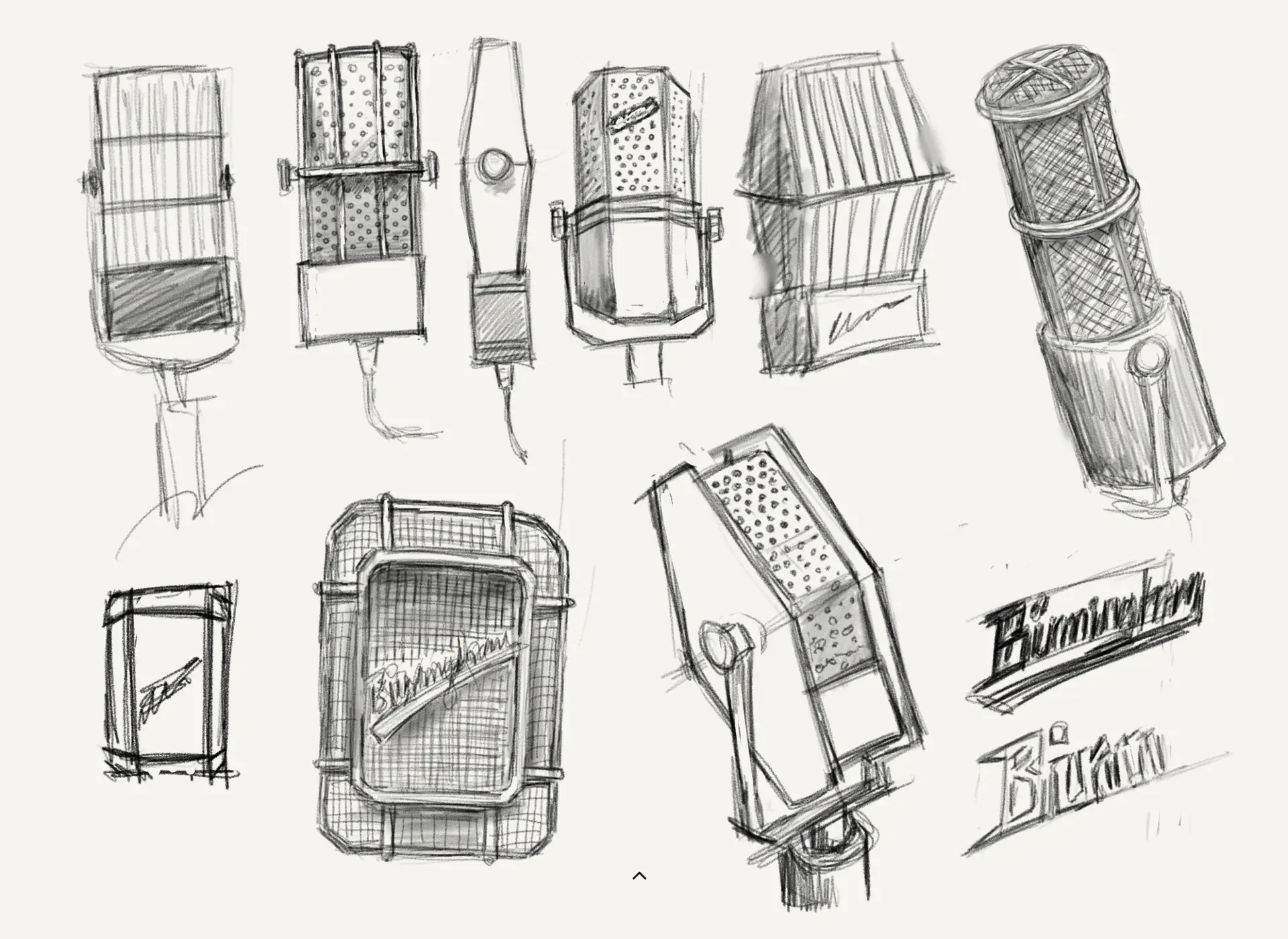
Left: front/side two-view sketch showing both the nameplate and the Alabama/bars motif simultaneously. Right: angled pencil rendering with material shading. Below: the finished render showing the Alabama state outline filled with jail bars on the side panel.

I Have a Dream
Embedded Clue
“WDRM” — a vintage broadcast call-sign badge mounted above the grille. DRM as shorthand for Dream.
A broadcast signal for the speech that broadcast a vision to the world. You might not notice it the first time.
Top: sketch pages showing the evolution from early form studies to the final DREAM badge design. Below: the finished vector badge — the WDrM call sign in period-appropriate lettering.

The Drum Major Instinct
Embedded Clue
A drum major silhouette centered in a circular medallion on the mic band, flanked by “DRUM” and “MAJOR” in period type.
The figure at the front of the march — leading, not following. The RCA capsule form references the era’s broadcast microphones.
Top left: RCA vintage mic reference alongside top-view form studies and drum/drumstick sketches. Top right: the drum major figure progression — from gestural scribble to refined silhouette. Bottom: the detailed mic sketch and three iterations of the badge label typography.

Remarks at Santa Rita Jail
Embedded Clue
The KQED call sign — the actual local broadcast station serving the Santa Rita area when King visited — rendered in period-accurate logo design, with “Serving in Santa Rita” added as a tagline.
Researched which station was broadcasting in Dublin, CA in January 1968. History, not invention.
Left: the original KQED station logo from the era, sourced from archival records. Right: the recreated badge with the period starburst-and-9 mark and the added tagline “Serving in Santa Rita” — making the connection to the speech’s location explicit without being obvious.

A Creative Protest
Embedded Clue
“Creative Protest” in chrome vintage lettering — the most direct clue in the set. The faceted cube form is the most unconventional silhouette of the six.
A speech about direct action gets the most unconventional form. The design is the argument.
in development

I’ve Been to the Mountaintop
Embedded Clue
“Zenith” — the brand name of a real electronics company, also a synonym for peak, summit, mountaintop.
He was dead the next day. The clue is the most quiet of the six — a single word that holds everything.
in development
Typeface & Title Cards
Authenticity is a design specification.

Designed by Tré Seals — Vocal Type Co. — Named after Martin Luther King Jr.
Martin — designed by Tré Seals of Vocal Type Co. — was built to evoke the typographic aesthetics of civil rights protest materials: condensed weight, urgent letterforms, the visual language of the movement.
It was chosen for cultural authenticity as much as visual accuracy. A typeface designed by a Black designer, named after King, built specifically to carry this historical weight — that lineage is inseparable from what the letterforms look like. A visually similar alternative would not be the same choice.
Each speech has its own title card — same typefaces, different layout, weight distribution, and spatial rhythm. Cohesive across all six, yet distinct within each one.


The pacing of old black-and-white film titles. A breath before the environment changes.
The Environments
Each speech. Each world. Each decision about what to build and why.

The March on Washington
Over a dozen protest signs — faithfully recreated from archival photographs — fill the OJRC office. Each bears a demand from the actual march: “We Demand Decent Housing Now.” “An End to Police Brutality Now.” “Effective Civil Rights Laws Now.” These are the demands from August 1963. They are the active work of OJRC today.
Each sign is positioned at actual human height. The crowd loads behind and to the sides of the user — turning around is the reveal. Subtle swaying animation makes it a crowd rather than a field of objects. Scale is the difference between a diorama and a demonstration.

Ebenezer Baptist Church
This speech was delivered from King’s own pulpit at Ebenezer Baptist Church — his congregation, his spiritual home. The environment was built from historical photographs of the interior during his pastorship.
Two elements define the space: decorative urns flanking the pulpit, positioned to mirror their actual placement in the original church, and rows of faithfully modeled pews. The OJRC office wasn’t the size of a church. The decision was to harmonize the two spaces rather than force one inside the other — Ebenezer Baptist and a civil rights law office, one continuous line.

The Jail Cell
King was arrested following a protest in Birmingham. While incarcerated, white ministers published “A Call for Unity” in the local newspaper, criticizing his methods of direct action. He was at a low point, isolated. From that cell, with whatever paper he could find, he began writing.
The cell was recreated from best-available photographs of Birmingham jail cells from the era. Three objects on the bunk: a Bible, a notepad with scrawled draft lines, a folded newspaper showing the article and photograph of his arrest. The cause and the response, three feet apart. The wall color: that specific acid yellow-green, the actual color of a mid-century Southern municipal lockup.
TUsers stand outside the bars, looking in. You can see what he had. You cannot enter it. What happened when some users crossed the threshold anyway is documented in section 07.
Three environments in active development.
Each one approached with the same depth of historical research and spatial design.
A Creative Protest
Environment concept in development.
Remarks at Santa Rita Jail
A semicircle of era-accurate television cameras facing the pulpit. A cyclone fence with barbed wire in the middle distance. The geometry of public address: the voice, the media witness, the jail behind.
I’ve Been to the Mountaintop
A surreal mountain peak rising behind the pulpit — distant hills and valleys visible beyond. Dream-like, not photorealistic. The only environment in the experience that dissolves into something beyond history, honoring the prophetic register of King’s final speech. He was dead the next day.
A Design Decision
Worth Examining
The threshold of the Birmingham jail cell.
Every environment required a decision about the user’s spatial relationship to the history it represents. For most environments that decision was clear: stand inside the march, stand inside the church. Be present.
The Birmingham jail cell was different. The question wasn’t just spatial — it was ethical. How do you represent another person’s suffering? How close do you let a stranger get to the most isolated, painful moment of King’s public life?
Outside the bars. Looking in.
The user stands in the office, facing the cell. The bars are in the foreground. The bunk, the objects, the acid yellow-green walls — visible, but through a threshold. The user witnesses. They do not occupy.
Inside the cell. Surrounded by walls.
Place the user inside the cell. Let the bars be around them instead of in front of them. Full immersion. Maximum presence.
The bars were designed as a threshold. Respectful distance. The right to witness without claiming ownership of someone else’s pain.
What happened: users walked through the bars anyway. And found something on the other side that the design couldn’t have planned. They turned around. Looked back at their own office through them. And in that moment, the designed threshold became something else entirely — a frame through which civil rights lawyers saw their own workplace as a continuation of the same struggle that had put King in that cell.
The most meaningful thing the design produced was something the design didn’t design — which is the best possible outcome for work like this.
Response
& Reflection
What happened when people stood inside it.
“The Dream Echoes On reflects an exceptional level of thoughtfulness and care. Its quiet emotional impact adds a motivating presence for those of us engaged in civil rights work.”—Ben Haile, Attorney, Oregon Justice Resource Center
That response captures the professional validation — the client, the attorney, affirming it did what it was intended to do.
When the protest signs loaded behind the pulpit, people turned around. Saw the sea of signs. Said “wow.” Then walked into the crowd — moving among the signs, standing inside the March on Washington in their own office.
When they reached the jail cell, some of them crossed the designed threshold. Walked through the bars. And then turned around again. Looked back at their office — their desks, their doors, their colleagues’ workspaces — through the bars of a Birmingham jail cell.
Civil rights lawyers. Looking at their workplace through the bars of a Birmingham jail cell.
That moment wasn’t scripted. It happened because the design was grounded in something true — and real people, moving through it, found their own meaning in it. You can’t plan for that. You can only build the conditions.
The medium was augmented reality, the method was spatial computing — but the discipline was interpretive design. The same question a museum curator or memorial architect asks: how do I put someone inside a story rather than in front of one?